
After eight months of planning and design, technical facilities provider RaceTech has unveiled its largest ever OB truck. Galileo is a flexible, expandable truck that meets the increasing demand for an on-site presence at major horse racing events, while its flexible design means that it can also be utilised across other sports and live event productions.
“The remote production side of our business is definitely growing, I’d say 60-70% of the fixtures we do now have an element of remote production,” explains John Bozza, RaceTech CEO. “But, on the flip side of that, we found that with the bigger fixtures, such as Royal Ascot, the Epsom Derby and the Cheltenham Gold Cup, we were putting more kit and more people on course than ever before. We were sending two or three OB units to cover various rights holders and to cover racecourse TV. It was just getting bigger and bigger, so we realised that we needed a bigger truck to cut down on fuel, drivers and so on.”
The result is Galileo, an expandable 4K-ready truck built on baseband infrastructure with three production spaces, two audio spaces and 20+ camera capability. The vehicle, designed and built by Spanish coachbuilder Tecnove alongside UK-based systems integrator Megahertz, successfully made its debut at Royal Ascot, although not working to full capacity.
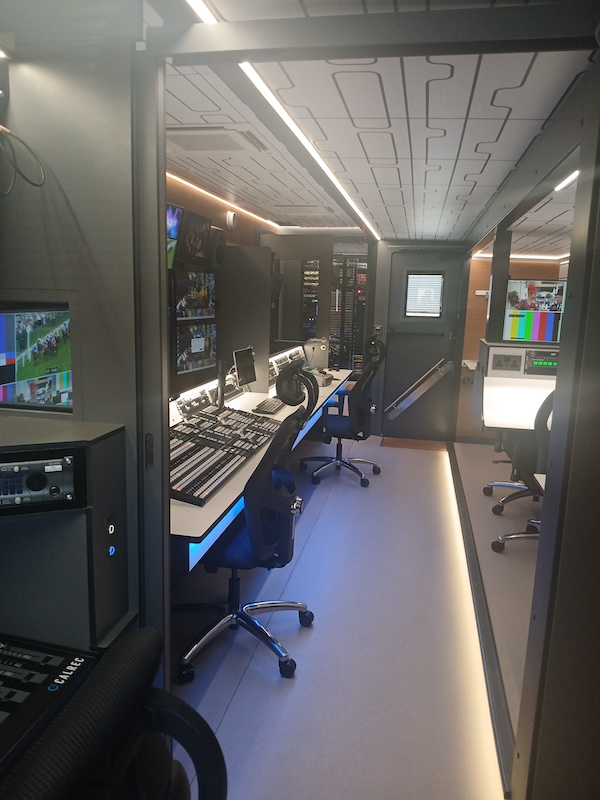
“It went really well and it made some good noise in the OB compound – people were pleased to see it,” says Bozza of the first outing. “It’s good for our staff and good for the customers – it’s a really nice build and I’m impressed with it.”
Comfort and adaptability were at the core of the design. Separate entrances for the different workspaces ensure teams can operate without interruption. The two sound suites can be combined or separated depending on the needs of the production, and there’s also three separate multifunctional production spaces that can adapt to the specific needs of a project. Windows ensure sightlines throughout the truck are maintained no matter the configuration chosen.
The 170sqft main production space can accommodate up to 10 people and features a 64-input Sony MLS-X1 vision mixer. Other kit throughout the vehicle includes a Calrec Argo M36 fader desk, TSL audio monitor, RTS Odin talkback system, Sony OLED 4K monitors, Vislink Quantum RF and FocalPoint telemetry, and a Ross Carbonite Ultra vision mixer.
“Every available square metre was carefully optimised to create clearly defined operational areas while maintaining comfortable circulation and an efficient working environment for the production crew,” explains Tecnove’s María Elena Gijón Correas. “A key feature is the expandable body system, which significantly increases the available workspace once deployed without compromising the vehicle’s functionality. In addition, the interior was designed with a modular approach, making it straightforward to integrate new equipment or future technology upgrades without requiring major structural modifications.”
While Galileo is expandable on both sides it can also be operated with one or neither side expanded. “We don’t have to expand either side and it can just be used as a remote production truck,” explains RaceTech commercial director James Gray. “So we could bring in 20 cameras, send them all to the gallery in London and the truck never expands. It’s even multifunctional in how big we make it. This truck can just as easily do an eight-camera remote production as it can go to Royal Ascot and run 40 cameras and three different productions.”
This level of flexibility did create something of a design challenge for Megahertz and Tecnove, particularly when it came to making the expanding pod on the side of the main production space fit.
“It was a challenge because there was no space for that to fold into,” says Simon Walder, senior project engineer at Megahertz. “We had to do some clever things with how the rear desks fold up to allow that to fold over the main production space because there was nowhere else for it to go. It’s a small pod but it was the biggest space design challenge.”
“One of the really cool bits about the design process with RaceTech and Tecnove was getting the three of us in a room together, and in one afternoon, live on screen, moving around all of the elements in that pod,” recalls Jon Flay, managing director at Megahertz. “We completely redid the configuration to make it more workable and the Tecnove design guys juggled desks and workstations live in SolidWorks as we were talking, which is pretty remarkable. The experience of live design change with them was really positive.”
Read more A hybrid future: RaceTech expands remote production galleries at London HQ
The built-in flexibility also creates the opportunity for RaceTech to work across other sports and live events.
“With racing, we’re probably looking at around 30 days coverage [for this truck], so it’s definitely got some capability to go out and potentially do other work,” says Bozza. “We tried to build it with as much flexibility as we could, whether that’s EVS or Evertz for replay, or in the production spaces which can be moved around to make one big area or two smaller ones. We can be really flexible in how we move things around within the unit.”
As with the rest of RaceTech’s fleet, sustainability was also a key part of the design and there was a clear focus on maximising the vehicle’s service life by simplifying maintenance and facilitating future upgrades. In addition, Galileo can run on HVO fuel and features a roof-mounted 1kW solar array. It is also equipped with high-efficiency Daikin air conditioning systems and a full LED lighting installation to minimise power consumption during operation, while the electrical design is FIFA-compliant. The real innovation, however, is the Victron Quattro inverter system which will provide around an hour of runtime in the event of total power failure.
“The vehicle’s got two independent inverter chains with lithium batteries,” explains Walder. “We’ve found that the inverter systems are much more robust and reliable than a traditional UPS. It also gives that flexibility to add in the solar element, which you don’t get with the UPS. So, a lot of the DC systems, all the CCTV and a lot of the lighting all runs off the batteries that are solar charged, and then there’s a one-hour backup on each technical input chain.”
With Galileo set to head up to Yorkshire for its next outing later this month, all parties agree that the final product is a great advert for co-operation and innovation, with teamwork central to the success of the project.
“This was our first project with Megahertz, but the collaboration was positive and highly productive from the very beginning,” says Correas. “Although we are based in different countries, distance never became an obstacle thanks to clear, transparent and continuous communication between both teams. It is a project we are particularly proud of, not only because of the technical solution we have delivered, but also because we successfully transformed the customer’s operational requirements into a vehicle tailored precisely to their needs. We are extremely pleased with the final result.”
Flay agrees: ” Everything flowed very well with Tecnove, and RaceTech is a terrific client. It’s always a pleasure working with people who know their business so well – it’s been a great partnership.”