
RaceTech is delighted to announce a new race Commentator; Gary Capewell will join the RaceTech roster as an official Commentator from 1st June 2026.
After a rigorous selection process taking place over multiple rounds, a short list of high-quality candidates were put through their paces and asked to perform live commentaries on course, at selected fixtures. Whilst their commentary was not broadcast, it was judged by a selection committee made up of racecourse, broadcast, and bookmaker representatives. Competition was fierce and the standard very high, making it difficult for selectors to whittle down the applicants after each stage of the process.
Gary Capewell has a long-held passion for horse racing, being well known as a Commentator for the Arabian Racing Organisation (ARO), as well as point to point fixtures and various international fixtures. Gary is also a raceday presenter at several racecourses and has been commentating for bookmaker television and radio services.
Gary expressed his delight saying “Having applied before, I was thrilled to make it through this time, it’s all I ever wanted”.
He went on to say, “I’ve been interested in racing from an early age and living in Uttoxeter meant I got to go racing quite a bit”. I was lucky enough to spend some time and gain valuable experience with Commentator Martin Harris who let me practise my skills. I eventually took over from him commentating on the Arabian Races. I have since called over 1500 Arab races including in France, Poland and Sweden, I’ve also been a race caller for William Hill Radio and the Dubai Racing Channel. I can’t wait to get started as an official commentator on the RaceTech roster”.
James Gray, Chair of the Commentators User Group said, “Many congratulations to Gary for being selected to join the Racecourse Commentators roster. RaceTech was delighted to manage the selection process and would like to thank all those who applied. The quality of applicants has been outstanding, highlighting the level of talent and enthusiasm that is out there”.
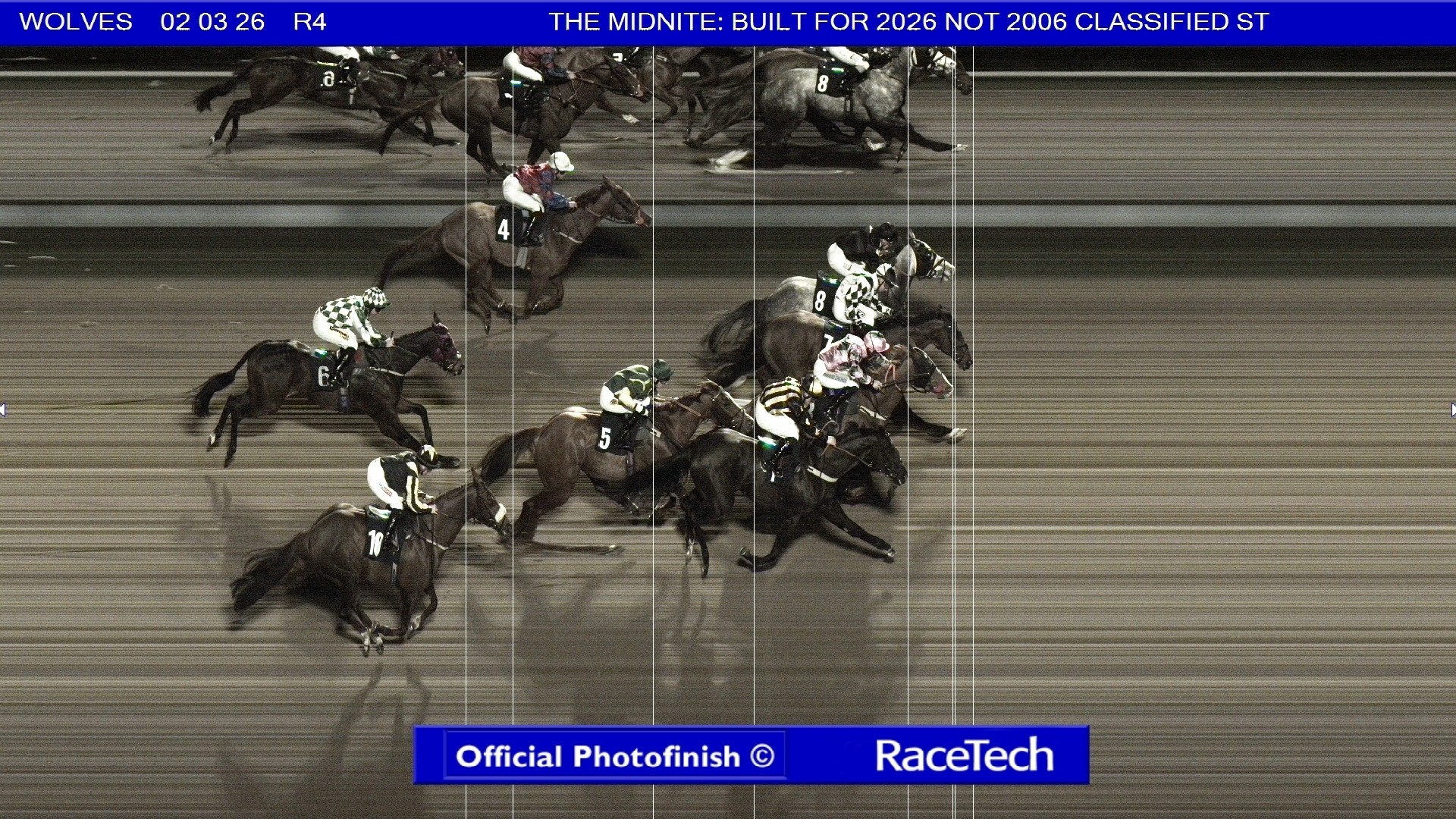
British Horseracing Authority (BHA) judges will now have access to improved photo finish images following the introduction of ultra high-resolution camera technology.
Lynx photo finish cameras, which capture images at around 6,000 frames per second – much faster than the equipment used previously – significantly improve the clarity of photos that help confirm the winner and finishing distances for each race.
This new technology is available at British racecourse, including this week’s Cheltenham Festival, where it will be the primary camera used for regulatory purposes alongside the existing backup and infield cameras to determine placings.
The enhanced images will give the BHA judging team a much clearer and more accurate picture, which will support quicker, more definitive decision making – especially in a tight finish or poor weather conditions.
The investment by RaceTech in upgraded equipment follows a trial period, and an ongoing role out process, during which the Lynx cameras have been tested extensively by the photo-finish operators and the BHA.
The images captured by the Lynx technology will be published on the BHA website and shared with broadcasters, to ensure consistency and transparency for participants and customers.
These will be provided in a new style, with additional enhancements planned to continually improve the information available when displaying race results.
BHA Judge and team principal, David Hicks, said:
“The introduction of Lynx photo finish cameras gives BHA judges access to the highest-quality images and supports us in calling the results of races to a much greater degree of certainty.
“The judging process itself doesn’t change, with our expert team still scrutinising the photo finish and exercising their judgement, but the new equipment provides us with a significantly enhanced picture from which we can make an informed assessment. This precision really matters, especially when horses may be split by a very small number of pixels.
“We always want to make use of the best, most advanced technology to help support decision-making on a raceday. While it won’t always be possible to split horses, with dead-heats an inevitability at times, the new technology will provide much clearer evidence that can help improve the clarity with which decisions are reached.”
John Bozza, RaceTech Chief Executive Officer, commented:
“RaceTech have been working very closely with Lynx camera systems and the BHA for the past 24 months developing the next generation of photo finish cameras.
“These new cameras not only offer greater resolution images but perform much better in lower light conditions. Lynx have also built a custom API to interface between the Lynx software and BHA platforms results data.
“We are delighted to support the BHA by investing in this new camera technology which will enhance the adjudication process”.
1. A photo finish image captured using the new, higher resolution Lynx camera technology
2. The same image captured using the older equipment
Ascot Racecourse, RaceTech, Ateme, Focal Point VR and Bluebell collaborate to deliver a groundbreaking live immersive video stream for horse racing
Ascot, UK – January 20, 2026 – Live sports broadcasting reached a new milestone last Saturday at the prestigious Ascot Racecourse with the debut of the world’s first live ultra-high-resolution immersive broadcast of a horse racing event, delivered in real time with unprecedented depth, clarity, and realism.
The Ascot showcase demonstrates how live sport can be experienced with a heightened sense of presence, bringing audiences closer to the action through workflows designed specifically for next-generation immersive video. It was made possible through a close collaboration between Ascot Racecourse, RaceTech, Ateme, Focal Point VR Ltd, and Bluebell Opticom across capture, encoding, connectivity, and on-site deployment:
- Focal Point VR deployed its multi-8K sensor immersive camera system, delivering stereoscopic depth and clarity with an extraordinary 37 pixels-per-degree fidelity.
- Bluebell Opticom provided its flexible fiber connectivity solution to link Focal Point VR’s camera system and processing engine.
- Ateme’s TITAN encoder processed the ultra-high-resolution content in real time, encoding directly into Apple’s MV-HEVC immersive format for seamless playback on Apple Vision Pro.
- RaceTech and Ascot Racecourse supported the live racing environment and operational integration for the demonstration.
This collaboration sets a new reference point for live immersive sports broadcasting, demonstrated through a real-time experience delivered to selected VIP guests at Ascot on race day.
 Graham Badger, Head of Media and Broadcast, Ascot Racecourse, said: “This demonstration at Ascot showed the power of collaboration across the industry. Together this technology can push the boundaries of what fans can experience in real time, bringing people closer to the heart of the sport and making them feel as though they’re truly there. We see this as a major step forward, and we’re excited by the opportunities it will create for our audiences.“
 James Gray, Commercial Director, RaceTech, said: “With innovation being so important to RaceTech, the team are delighted to be involved in the delivery of this live immersive experience. Ascot Racecourse is a world-renowned venue of sporting excellence, so is a fitting place to demonstrate this technology. The immersive experience really makes it feel like you have been transported into the parade ring. I am confident this demonstration will provide innovative opportunities for RaceTech’s existing customer base and a multitude of other applications in live events.”


 “For immersive production to operate reliably in real world environments, the transport layer must deliver uncompromising performance,” said Anil Parmar, Sales and Marketing Director at Bluebell Opticom. “This deployment demonstrates that uncompressed 8K video and control signals can be carried over fibre infrastructure with the performance and confidence required for next generation immersive workflows.“
About Ascot
Racecourse Ascot Racecourse was founded in 1711 by Queen Anne, who identified the land as being ideal for horseracing when riding out from Windsor Castle. The first four-day meeting at Ascot took place in 1768 and at some point in time, the race programme started being referred to as Royal Ascot.
The two tracks, Flat and Jumps, now provide racing all year round and Ascot hosts 26 days of racing each year, including the five days of Royal Ascot. It is Europe’s premier Flat racing meeting, featuring eight Group 1 races and 19 Group races in total. Around 300,000 racegoers attend across the five days while the event is broadcast in more than 180 territories with a reach of 650 million households.
As well as world-class racing, Ascot Racecourse is also used as a film and TV filming location and as a venue for conferences, banquets, exhibitions, product launches and weddings, with 300 non-racing events annually. The land on which Ascot Racecourse sits is leased from the Crown Estate, adjacent to Windsor Great Park, covering 179 acres.
For more information, please visit www.ascot.com
About RaceTech
RaceTech is the dedicated technical facilities provider that has maintained British racing at the forefront of global broadcast technology for 80 years.
Originated as the Race Finish Recording Company in 1946 its portfolio of innovation includes the pioneering development of horseracing’s first photo-finish system and the introduction of full high-definition broadcast and state-of-the-art racecourse AV installations.
About Ateme
Ateme is a global leader of video compression and delivery solutions, helping tier-one content providers, service providers, and streaming platforms boost their viewership and subscriber numbers.
Leveraging an R&D task force that is unique in the video industry, Ateme’s solutions power sustainable TV services, improve end-users’ quality of experience, optimize the total cost of ownership of TV/VOD services, and generate new revenue streams based on personalization and ad insertion. Beyond offering technological agility, Ateme partners with its customers, offering flexible business models that match their financial priorities.
Find out more: www.ateme.com
About Focal Point VR
Focal Point VR Ltd is a UK-based immersive video technology company specialising in live ultra-high-resolution stereoscopic capture and delivery.
The company designs and deploys end-to-end immersive broadcast systems combining advanced multi-sensor camera hardware, real-time processing, and high-efficiency encoding to deliver exceptional depth, clarity and realism.
Focal Point VR works with broadcasters, technology partners and rights holders to enable live immersive experiences across sport, music and premium events, bringing audiences closer to the action while integrating seamlessly into existing broadcast workflows.
About Bluebell Opticom
Bluebell Opticom designs and manufactures fibre optic links for the broadcast, telecommunications and professional AV industries. With more than 30 years of engineering experience and a Technical Emmy Award recognised in 2017, the company has played a key role in advancing fibre based transport of video, audio and data.
Bluebell supports a global customer base, supplying broadcasters, systems integrators and network operators across Europe, North America and Asia. Its solutions are widely used in studios, outside broadcast, live events and other mission critical environments. All products are designed and manufactured in house in the United Kingdom, ensuring quality, consistency and long term support.
See link below for full story…
RaceTech and BMC TV are proud to announce a ground-breaking partnership that has
secured a multi-year, multi-million-pound contract with The Racing Partnership (TRP).
Starting in 2025, this collaboration will deliver advanced media connectivity and remote
production solutions, setting a new standard for the horse racing and broader sports
broadcasting industries.
This strategic partnership leverages the strengths of both companies. RaceTech’s indepth
knowledge of horse racing along with their state-of-the-art Raynes Park remote
production facility will serve as the hub for TRP’s transition to a fully remote production
workflow, while BMC TV will provide the critical connectivity infrastructure required to link
TRP’s racecourses and broadcast partners across the UK and globally.
John Bozza, CEO of RaceTech, expressed his enthusiasm for the partnership: “We are
delighted to have secured this long-term contract with TRP and are excited to transition
them to our Raynes Park remote production facility. To ensure that we can offer the most
advanced, complete, and reliable service, we have teamed up with BMC TV, who will be
providing the contribution connectivity to TRP’s racecourses and distribution to their
broadcast partners in the UK and overseas. All services will be monitored and controlled
from a dedicated Master Control Room at Raynes Park, I am confident that this
partnership will offer great value to TRP and provide significant opportunities to develop
and deliver remote production solutions to a wider customer base and multitude of
sports.”
David Meynell, CEO of BMC TV, echoed this excitement: “This is a fantastic contract win
for BMC TV, and we cannot wait to get started. The partnership with RaceTech is
significant and one that allows us to offer maximum value to our customers, with
complete focus on the benefits that we can bring to the racing industry. We believe that
we are best placed now to offer value to all UK, Irish, and overseas horse and greyhound
racing, and we are confident that we will secure further contracts, continue to grow BMC
TV, and become the go-to provider for remote services to the racing industry and other
sporting events.”
Mark Kingston, Director of Media Technology and Production at TRP, commented on the
collaboration: “We are incredibly impressed with the advanced technological solutions
that RaceTech and BMC TV have developed to support our horse racing operations. This
partnership will not only enhance the quality and reliability of our broadcasts but also
future proof our production capabilities. RaceTech’s innovation in remote production,
combined with BMC TV’s exceptional connectivity services, provides us with a worldclass
solution that will support the business-critical services we provide to the betting
industry and to domestic viewers of over 700 UK horse race fixtures per annum.”
RaceTech’s continued commitment to innovation and excellence has made it a trusted
name in broadcasting for over 75 years. Its remote production capabilities, highlighted by
the cutting-edge Raynes Park facility, represent the future of efficient and sustainable
broadcasting.
BMC TV’s unparalleled expertise in live event connectivity and its resilient Media Network
including the innovative and unique LMX Live, bring unmatched quality and reliability to
this partnership. With its ability to deliver uncompressed, resilient, and global
connectivity solutions, BMC TV is poised to elevate TRP’s production and distribution
capabilities to new heights.
This landmark contract is a testament to the shared vision of BMC TV and RaceTech in
revolutionizing the racing and sports broadcasting landscape. Together, the companies
look forward to driving significant growth and innovation in the years ahead.
RaceTech is a leading provider of broadcast, production, and technical
services to the horse racing industry. With a legacy spanning over 75 years, RaceTech is
renowned for its innovation and commitment to excellence, delivering high-quality
content and cutting-edge solutions across 60 racecourses and beyond.
BMC TV specialises in live event connectivity, offering robust and
reliable solutions for audio, video, and data transmission. With expertise in both
compressed and uncompressed broadcast signals over IP, satellite, microwave, fibre,
and terrestrial networks, BMC TV is a trusted partner for media and live broadcast events
globally.

RaceTech the outside broadcast and technical services provider to British horseracing has
renewed its service agreement contracts with Jockey Club Racecourses (JCR).
A new multi-year service agreement is in place from October 2024 with Jockey Club
Racecourses covering all fixtures at its 15 racecourses including several major festivals such
as The Cheltenham Festival, The Randox Grand National at Aintree and The Betfred Derby at
Epsom Downs. The new contract consists of standard and additional Raceday services running
until 2029.
RaceTech service agreements are tailored to suit, supplying essential and supplementary
Raceday services, such as the provision of photo finish, video brochures, starting stalls, race
timing, public address and racecourse TV production. The service agreements also cover the
provision of goods and services outside of a Raceday, supporting racecourse upgrades and
projects.
John Bozza, Chief Executive at RaceTech said, “We are delighted to renew our service
agreement with JCR. We enjoy good relationships with the teams across all the JCR
racecourses, as we have for many years. It is a pleasure to continue to provide these services
and work with the tracks to develop their on-course technology and therefore enhance the
customer experience.”
Amy Starkey, Managing Director of Jockey Club Racecourses, added, “RaceTech play a huge
role in helping us deliver nearly 350 fixtures a year, large and small, and are responsible for
so much of what goes on behind the scenes.
“Many racegoers might not appreciate just how many aspects of a Raceday the team at
RaceTech are responsible for and how closely our teams work with theirs. We’re delighted
that this partnership is continuing.”

RaceTech, the outside broadcast and technical services provider to British horseracing is
delighted to have extended its Outside Broadcast (OB) and raceday services partnership with
Chelmsford City Racecourse for a further five years.
A new all-inclusive agreement incorporates the full OB provision along with essential race day
services. Notably included in this agreement is the addition of a secondary branded
Racecourse TV output, supplementary to the main Racecourse TV output, focusing on
additional data and away racing. One other significant inclusion is the provision of a remotely
controlled Pan, Tilt, Zoom (PTZ) camera covering the horses parading in the paddock and the
post-race presentations, greatly enhancing the on-course customer experience.
Raceday integrity services such as starting stalls, public address and photo finish form an
important part of the Chelmsford City Racecourse new contract which runs up until October
2029.
John Bozza Chief Executive at RaceTech said, “We have enjoyed working with Chelmsford City
Racecourse for many years and are delighted to have renewed and expanded our partnership
in a new contract. The inclusion of the second Racecourse TV channel and the introduction of
remote camera systems is a meaningful step forward. We look forward to another five years
working with and supporting one of the busiest courses in the country.”
Neil Graham, Racecourse Director, at Chelmsford said, “We are delighted to continue our
relationship with RaceTech and look forward to developing, in particular, the new data and
away racing output. At Chelmsford City Racecourse, we are constantly striving to improve our
product for our customers and trust that these new innovations will keep the racecourse at
the forefront of British racing.”

RaceTech, the outside broadcast and technical services provider to British horseracing is
delighted to have further extended its existing services partnership with Goodwood
Racecourse taking it up to the end of 2029. Goodwood Racecourse is home to the Qatar
Goodwood Festival and hosts top quality flat race meetings throughout the summer season.
RaceTech service agreements are tailored to suit, supplying essential and supplementary
raceday services, such as the provision of photo finish, video brochures, starting stalls, race
timing, public address and racecourse TV production. The service agreements also cover the
provision of goods and services outside of a raceday supporting racecourse upgrades and
projects.
John Bozza, Chief Executive at RaceTech said, “We are delighted to extend our agreement
with Goodwood Racecourse. We enjoy excellent relationships with the Goodwood team
across all levels and working with them to enhance their customer experience with latest
technology at this beautiful and unique venue.”
James Crespi Racecourse Director at Goodwood Racecourse said, “We are delighted to extend
our existing agreement with RaceTech for 10 years, taking us up to the end of 2029. As our
long-term partnership continues, we look forward to delivering the highest quality product
together.”
